
Key Takeaways
- Social anxiety deeply impacts daily life, leading to overwhelming feelings in social situations.
- Physical symptoms include blushing, sweating, and a racing heart, while emotional symptoms involve fear of judgment and self-criticism.
- Biological factors, such as brain chemistry and genetics, play a role in social anxiety but do not dictate one’s life permanently.
- Exposure therapy and Cognitive Behavioral Therapy (CBT) are effective, research-based treatments that help manage social anxiety.
- Anxiety expert Dr. Sarah Allen offers personalized support to help you build confidence and navigate social situations more comfortably.
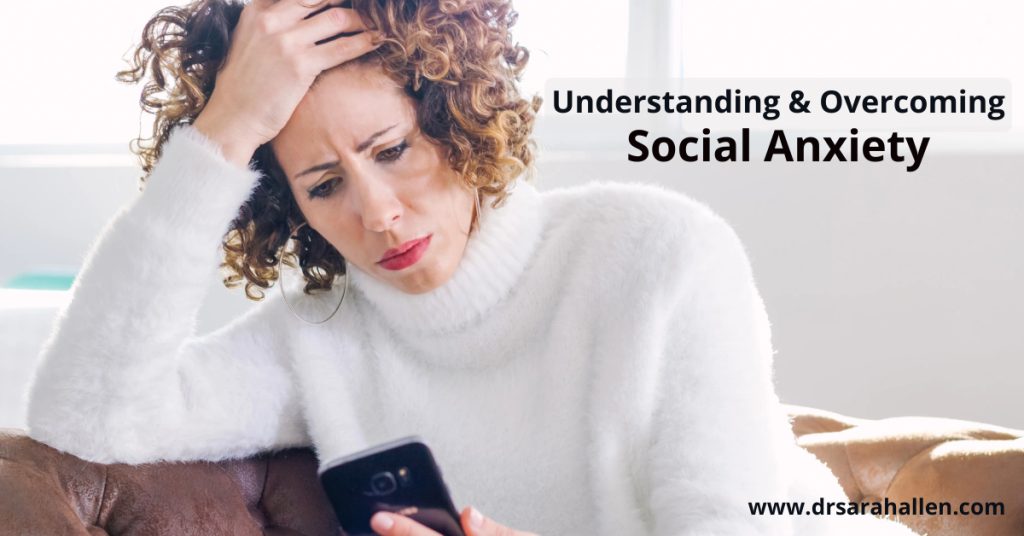
Social anxiety can affect someone’s daily life in ways that people on the outside might not recognize. For the person living with it, something as simple as answering a question in a meeting or making small talk can feel overwhelming. It can be mentally exhausting worrying about what others might think in everyday moments.
The question I hear most often is, “Why do I feel like this?”. I’ve found that when someone starts to learn what’s beneath their social anxiety, things start to shift for them. Once you know why your mind and body react a certain way, it feels less like you’re broken and more like you have a path out. The causes reach beyond just being shy or overthinking. It often comes from both your biology and your life experiences. The best part is, there are ways to manage social anxiety that do not mean changing who you are. It’s more about changing how you see and respond to those patterns but firstly, lets look at what social anxiety is.
Symptoms of Social Anxiety
Social anxiety symptoms typically involve an intense fear of being judged or scrutinized, accompanied by physical reactions like blushing, sweating, or a racing heart, and negative thought patterns such as self”‘criticism and anticipatory worry. These symptoms then lead to avoidance and emotional distress that interfere with daily life, relationships, work, or school. There can be a difference in intensity in different types of social situation but for a formal diagnosis there needs to be a persistent fear in many types of social situations, usually lasting six months or more, and clear functional impact.
Physical Symptoms
- Blushing, sweating, trembling, or a fast heartbeat during or before social activities.
- Upset stomach or nausea, dizziness, shortness of breath, or muscle tension.
- Rigid posture, shaky or very soft voice, difficulty making eye contact.
- Panic symptoms in severe or extreme social anxiety symptoms, particularly during performance demands.
These are the symptoms of social anxiety that people notice first, often misread as “nerves,” though the intensity and persistence set them apart.
Thought and Emotional Symptoms
- Intense fear of being judged negatively, embarrassed, or rejected in social settings.
- Anticipatory anxiety for days or weeks before events and post”‘event self”‘critique with worst”‘case expectations.
- Cognitive freeze which is the feeling that your mind “goes blank” and trouble thinking clearly under social pressure.
- Heightened self”‘consciousness and hypersensitivity to criticism that fuel social anxiety indicators.
Behavioral and Avoidance Patterns
- Avoiding parties, group conversations, interviews, phone calls, or returning items to a store.
- Enduring social events with marked distress, planning exits, or minimizing participation.
- Low assertiveness and limited eye contact that reinforce social anxiety disorder signs over time.
- Performance”‘only fears such as public speaking or auditions, with relatively fewer fears in other settings.
These patterns can spiral. Avoidance reduces immediate discomfort but then cements symptoms social anxiety into daily routines and long”‘term habits.
The Biological Side of Social Anxiety
Our brains are wired to help us stay safe, but sometimes they get caught in loops that aren’t helpful. When I meet with clients who feel anxious in social settings, I point out that part of this response comes from how certain structures in the brain work. There are parts of the brain that manage fear and scan for anything that might feel threatening. If these areas are extra sensitive, social situations start to feel risky, even when nothing is actually wrong.
Brain chemistry plays a role too. Some people may have natural differences in the chemicals that help manage mood and handle stress. This does not mean anything is broken within them. It just means their brains respond more strongly to stress. Genetics can play a part as well. Many women have told me about similar worries that seemed to run in their mothers or siblings. While this kind of family history does not cause social anxiety directly, it can affect how sensitive you are to social situations.

To read more about how brain chemistry can affect anxiety see Anxiety, The Brain & How Therapy Helps.
The most important thing here is that biology is only a single part of the puzzle. It might explain why your responses feel so strong, but it does not mean you’re stuck with these feelings for life. The brain can change and adapt. Small changes in thought and action begin to influence how the brain responds. Talking with an anxiety specialist and learning new tools makes this shift possible.
Individualized support goes a long way. I know that everyone’s journey is different, and a personal approach, rather than a cookie cutter approach can make a big difference.
What We Learn from Our Environment
The people, places, and events in your life shape can all have an affect on how you behave socially. If you were left out or bullied at school, even as an adult, your body might hold onto old fear, long after the real danger has passed. You might notice that your current friends are kind and supportive, yet your nervous system brings back those earlier patterns of discomfort so it is hard to trust people.
Social anxiety usually doesn’t start overnight. Many of the women I see grew up in homes where conflict was tiptoed around, or hard feelings were swept under the rug. Then, big transitions like going off to college or becoming a parent can add new layers of worry. Life changes often bring up old feelings, especially when there’s a sense that you must be perfect, cheerful, or always ready to engage.
Family dynamics can also be important. If you come from a household where it was safer to stay quiet, it might still feel risky to speak up today. I’ve also noticed that the pressure to fit certain cultural standards can add tension, especially if those standards don’t match how you truly feel. All these pieces can help shape the way social anxiety shows up for you.
The pressure to act, or be a certain way can feed anxiety if what you are doing isn’t connected to your own value system. This article discussed that in more depth Being Authentic: Boost Self-Esteem and Reduce Anxiety By Listening To Your Core Beliefs.
Behavior Patterns That Feed Social Fears
Avoidance might sound like a gentle solution, but it almost always makes social anxiety stronger. I see it a lot: someone begins to skip group events, stops texting friends, or pretends to be fine when they’re anything but. Each time, the relief is quick and temporary, but the belief grows that something awful would have happened if they’d gone.
Self-criticism can also be a factor. Maybe after a conversation, you replay what was said in your head, worrying you sounded odd or that you made a mistake. When that loop runs long enough, it becomes automatic, fueling a silent belief that social risks are dangerous or embarrassing.
To read more on how what we say to ourself can affect our emotions and behavior see Understanding Self-Talk and Its Effects on Mental Health.
One of the first steps in my sessions is helping clients gently spot their own patterns, without giving themselves a hard time. We work together to make small, safe changes that don’t feel overwhelming. Sometimes this is as simple as lingering an extra minute at an event or reminding yourself to speak kindly to yourself after a tough conversation. By trying out new behaviors, one by one, you can start to build new confidence.
I may ask you to map out a list of social situations—starting from the least scary to the most challenging—so we can practice together first and imagine positive results. This slow and steady process lets you regain trust in yourself at your own pace.
What Can Help: Research-Based Treatment Approaches
There are good, well-studied tools that really make a difference with social anxiety. I find that Cognitive Behavioral Therapy, or CBT, helps many people get a fresh angle on their thoughts. With CBT, you learn how to spot old, automatic ideas that pop up in social situations, check if they’re true or over-the-top, and then practice replacing them with new thoughts that are less harsh and critical. After doing this for a while, your natural reactions start to shift in a more comfortable direction.

For more general information about Cognitive Behavioral Therapy read CBT For Anxiety: What It Is & How It Works.
Exposure Therapy is another strategy I use with clients, but it happens slowly and with plenty of support. We pick tiny steps and repeat them until your body and mind stop reacting as if something terrible is about to happen. Real growth comes by staying with the feeling, just long enough for the anxiety to settle down.
For more information about not avoiding emotions read Manage Overwhelming Emotions: Proven Distress Tolerance Techniques.
Building social skills makes these changes become a new habit. Many people tell me they worry about running out of things to say or how to step away from a conversation that’s dragging on. We practice skills together, using real examples from your daily life. This helps things feel natural so that future interactions don’t feel like something to survive, but chances to connect.
I offer both in-person and teletherapy options for anxiety, which means more flexibility for balancing work, family, and your own well-being.
A Path Toward More Comfortable Social Interactions
Social anxiety often tries to convince you to stay invisible, keep your head down, and avoid attention. But with the right approach, social opportunities start to open in meaningful ways. I’ve watched this happen with so many clients who start to feel more present—like they do not have to hide anymore. As people experiment with one small change, then another, they begin to discover their own voice and learn that most social situations aren’t as scary as they once seemed.
My clinical experience has shown me that the roots of social anxiety can be addressed and then you can uncover what feeds your tension and what helps you calm it right now. Even one small step can mark the start of real change and eventually you’ll discover more options than you thought possible.
Feeling stuck in social situations can take a real toll, especially when it’s been going on for a long time. I’ve supported many clients who have found relief once we slowed things down and looked at what was really fueling their anxiety. If you’re ready to feel more at ease around others, I offer support through anxiety counseling that helps you build confidence in a way that feels comfortable and manageable. For personalized anxiety (or one of the other issues I treat) treatment, contact me, Dr. Sarah Allen. I see clients in my office in Northbrook, a North Shore Chicago suburb, or virtually across IL, FL and the UK.

If you have any questions, or would like to set up an appointment to work with me and learn how to reduce anxiety, please contact me at 847 791-7722 or on the form below.
If you would like to read more about me and my areas of specialty, please visit Dr. Sarah Allen Bio.
Dr. Allen’s professional licenses only allow her to work with clients who live in IL, FL & the UK and unfortunately does not allow her to give personalized advice via email to people who are not her clients.
Dr. Allen sees clients in person in her Northbrook, IL office or remotely via video or phone.

What Can I Read That Helps Me While I Am Waiting For My First Appointment With Sarah?
Download this free booklet to gain valuable insights and practical strategies for managing anxiety and worrying.














As featured in