
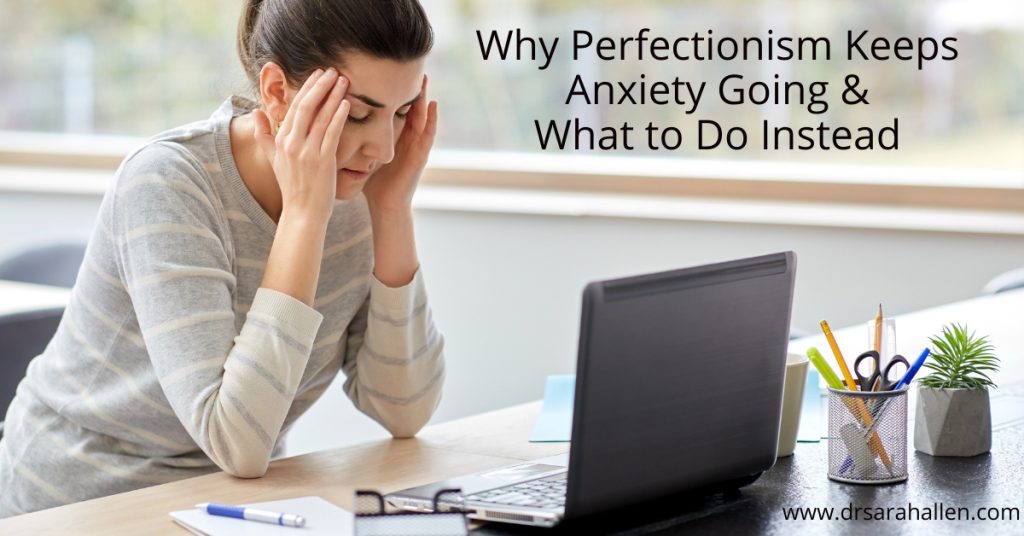
Perfectionism sounds helpful at first. You want to do things well, be responsible, and avoid mistakes. But when doing your best turns into pressure to never slip up, anxiety usually follows close behind.
Many people I see for anxiety counseling are surprised when I start talking about perfectionism. They thought they were just type A or hardworking. In this post, I will explain what perfectionism really is, how it keeps anxiety going in your brain and body, the hidden costs it carries, some specific changes you can begin to practice, and how I help people with this pattern in therapy.
Key Takeaways
- Perfectionism often masks itself as high standards but leads to increased anxiety and self-criticism.
- People may not recognize their perfectionism until it triggers chronic worry and emotional distress.
- The perfectionism-anxiety cycle keeps escalating with higher expectations and fear of failure.
- Therapy focuses on understanding perfectionistic thoughts, practicing balanced thinking, and engaging in behavioral experiments.
- Seeking professional help becomes essential when perfectionism causes significant stress or hinders daily functioning.
Table of contents
- What Perfectionism Really Is (and What It Is Not)
- How Perfectionism Fuels Anxiety in Your Brain and Body
- Hidden Costs of Perfectionism You Might Be Overlooking
- How I Treat Anxiety and Perfectionism in Counseling
- Mindset Shifts and Small Experiments to Calm Perfectionism
- When Self-Help Is Not Enough
- Ready to Work on This Together?
- Questions I Often Hear About Perfectionism and Anxiety
What Perfectionism Really Is (and What It Is Not)
Perfectionism is not the same as being motivated or ambitious. You can care about your work, family, or health without being perfectionistic. Perfectionism usually includes:
- Harsh self-criticism when you make even small mistakes
- Intense fear of failure or of letting others down
- A sense that your worth depends on performance
Some common perfectionistic patterns include:
- All-or-nothing thinking, such as if it is not perfect, it is a failure
- Over-checking emails, messages, or tasks before sending them
- Procrastinating because the task feels too big to do
- Re-doing tasks that were already fine
- Asking for a lot of reassurance that something is okay
Perfectionism can show up in many areas of life: work performance, parenting standards, friendships, body image, schoolwork, or health habits. Sometimes it looks like rigid dieting. Sometimes it shows up as emotional eating after trying to be perfect” all day.
Perfectionism often overlaps with anxiety disorders and depression. In anxiety counseling, I pay close attention to perfectionistic thoughts and behaviors, because they usually keep the anxiety cycle going even when you already understand that your standards are too high.
How Perfectionism Fuels Anxiety in Your Brain and Body
Your brain is always scanning for signs of danger. When perfectionism is running the show, the “danger” becomes mistakes, criticism, or not meeting impossible standards. Your nervous system stays in threat mode, as if something bad is about to happen.
That can look like:
- A racing mind, replaying conversations
- Tension in your shoulders, jaw, or stomach
- Feeling wired at night and exhausted in the morning
Recent research has linked perfectionism with higher levels of generalized anxiety, social anxiety, and depression. It is also tied to higher stress, trouble sleeping, and more physical complaints like headaches and stomach issues. Studies suggest that people with high levels of self-critical perfectionism tend to experience stronger and more persistent anxiety symptoms over time.
One way to picture the perfectionism-anxiety cycle is:
1. You set unrealistic standards.
2. You fear not meeting them.
3. You either over-prepare or avoid the task.
4. You feel brief relief.
5. Next time, the standards get even higher.
This cycle can get especially intense during big life transitions, such as starting a new job, becoming a parent, going through fertility struggles, or entering menopause. Expectations from yourself and others feel higher, so perfectionistic habits tighten and anxiety rises.
From a mental health perspective, this pattern shows up often in generalized anxiety disorder (ongoing, wide-ranging worry), social anxiety (fear of being judged or embarrassed), and obsessive or compulsive patterns (feeling driven to check or repeat behaviors). In my work, I help you understand which of these patterns fits best and how perfectionism is feeding it.
Hidden Costs of Perfectionism You Might Be Overlooking
From the outside, perfectionism can look like success or discipline. Inside, the costs add up.
Emotional costs often include:
- Constant worry about what you missed or should have done
- Guilt and shame when you cannot meet unrealistic standards
- A painful sense of never feeling “good enough,” even when others praise you
Behavioral costs can be:
- Procrastinating on tasks that feel too risky to do imperfectly
- Avoiding new opportunities, promotions, or relationships
- Spending far more time on tasks than they actually need
- Struggling to delegate or ask for help because “no one will do it right”
Perfectionism also strains relationships. You might feel resentful when others do not care as much, or they may feel criticized if your standards are pushed onto them. Sometimes the pressure is silent: you hold yourself to impossible rules that no one else even knows you are trying to meet.
There are physical costs too. Long-term perfectionistic stress can show up as poor sleep, headaches, digestive issues, or chronic fatigue. Many people use food, alcohol, or over-exercise to numb the stress created by their own pressure.
How I Treat Anxiety and Perfectionism in Counseling
Anxiety counseling with me is a structured and collaborative process. I look closely at how your thoughts, feelings, and behaviors interact, then I help you practice new ways of responding so anxiety does not run your day.
When perfectionism is part of the picture, I usually start by exploring:
- What you learned about mistakes growing up
- How you connect your worth to performance or responsibility
- Specific situations that trigger intense self-criticism
I often treat anxiety and perfectionism using cognitive-behavioral therapy (CBT). In simple terms, that means I help you:
- Notice perfectionistic thoughts like I cannot mess this up
- Test how accurate and helpful those thoughts really are
- Practice replacing them with more balanced and realistic thoughts
When generalized anxiety disorder is present, I work with you to identify your main worry themes, understand how much time you spend worrying, and build skills to step back from worry instead of getting pulled into it. With social anxiety, I help you examine fears about judgment or embarrassment, and gradually practice real-life situations in a planned, supported way.
I also use solution-focused strategies, which means building on what already works for you, even in small ways, instead of only focusing on what is wrong. Behavioral experiments are another tool I use. Together, we choose small tests, like doing something at good enough instead of perfect, and then we observe what actually happens to your anxiety.
Across diagnoses, my goal is not to turn you into someone who does not care or to lower your standards to a level that feels wrong. My goal is to help you keep your motivation and values, but remove the anxiety, shame, and burnout that come with perfectionism.
Mindset Shifts and Small Experiments to Calm Perfectionism
A helpful shift is to move from perfect to effective or good enough for this situation. Perfect” is usually vague and unreachable. Effective asks, What is needed here, realistically?”
You can try a brief thought check when you notice perfectionistic thinking:
Name the thought: I am thinking I cannot make any mistakes.”
- Ask, Is this 100 percent true?”
- Ask, What is a more balanced, helpful thought right now?”
- For example, I would like to do this well, and it will still be okay if it is not perfect.”
You can also experiment with permission statements,” such as:
- I am allowed to be a learner.
- Done is better than endlessly re-done.
- My worth is not the same as my performance on this one thing.
Notice your inner critic and label it, instead of merging with it. For example, That is my perfectionism voice talking. This slight distance makes it easier to choose a kinder, more realistic response.
Behavioral experiments help your nervous system learn that good enough” is safe. Pick one low-risk spot, like:
- Sending a simple email without rereading it more than once
- Organizing one drawer for 10 minutes and then stopping
- Planning a basic meal instead of the most healthy or impressive one
You might also try:
- Setting a 20 to 30 minute timer for a task and stopping when it rings
- Delaying reassurance-seeking by 15 minutes and watching your anxiety rise, peak, and then fall on its own
Treat these as experiments, not tests. There is no pass-or-fail. The goal is to observe what happens to your anxiety over time when you allow good enough” in small, safe ways.
When Self-Help Is Not Enough
It may be time to see a mental health professional who specializes in anxiety and perfectionism if you notice:
- Near-constant worry or physical symptoms like chest tightness or stomach issues
- Frequent panic or intense fear in social or work settings
- Ongoing sleep problems or irritability
- Feeling stuck in procrastination, even on important tasks
Signs that perfectionism is a big part of the problem include:
- Spending hours on small tasks that others do quickly
- Avoiding projects because you are afraid you will not do them perfectly
- Feeling frozen by decisions because none feel perfect enough”
Perfectionism often travels with generalized anxiety disorder, social anxiety, obsessive or compulsive patterns, depression, and eating or emotional eating concerns. When I work with someone who has these concerns, I help them understand their diagnosis in clear language, outline a treatment plan, and teach specific tools they can practice between sessions.
If you recognize yourself in this description and you feel that self-help strategies are not enough, set up an appointment with me so we can unpack your specific triggers and patterns and then practice different, more helpful ways of responding.
Perfectionism is not a fixed personality trait. It is a set of habits and beliefs that were learned, often to help you feel safe or accepted. With awareness, practice, and the right support, those habits can change, and life can feel calmer, more flexible, and more your own.
Ready to Work on This Together?
I specialize in counseling for women and I often see that women expect a lot from themselves and can be very self critical which leads to the perfectionism-anxiety cycle. If anxiety is affecting your sleep, work, or relationships, you do not have to manage it alone. I use evidence-based anxiety counseling to help you understand your triggers and build practical coping skills that fit your life. We will work together at your pace so you can feel more in control and hopeful about the future. If you are ready to start, please contact me on the form below to schedule an appointment. I see my clients either in person at my Northbrook, IL office which is in the North Suburbs of Chicago or virtually across Illinois, Florida or the UK.
Questions I Often Hear About Perfectionism and Anxiety
A: High standards mean caring about quality while staying flexible when things do not go perfectly. Perfectionism goes further: it ties your self-worth to your performance, leads to harsh self-criticism after small mistakes, and keeps your nervous system in a constant state of threat. The key difference is not how much you care, but what happens internally when you fall short.
A: The relationship goes both ways, but perfectionism is most often the driver. When you set impossible standards, your brain treats any potential mistake as a threat, which activates the anxiety response. Over time, the two reinforce each other in a cycle: perfectionism raises the stakes, anxiety intensifies the fear, and both get harder to manage without targeted support.
A: Cognitive-behavioral therapy (CBT) helps you identify the perfectionistic thoughts that fuel anxiety, test whether those thoughts are accurate or helpful, and practice more balanced responses. Behavioral experiments — such as deliberately sending an email without re-reading it repeatedly — help your nervous system learn that “good enough” is safe. Over time, these small shifts reduce the anxiety that perfectionism creates.
A: Perfectionism itself is not a diagnosis, but it is a pattern that frequently drives or worsens anxiety disorders, depression, obsessive-compulsive tendencies, and emotional eating. In therapy, I treat perfectionism as a set of learned habits and beliefs rather than a fixed personality trait. That distinction matters because habits and beliefs can change with the right support.
A: It may be time to seek professional support if perfectionism is causing significant anxiety, interfering with sleep or work, or affecting your relationships. I specialize in CBT for anxiety and perfectionism, and I work with clients in person in Northbrook, IL and virtually across Illinois, Florida, and the UK.”

If you have any questions, or would like to set up an appointment to work with me and learn how to reduce anxiety, please contact me at 847 791-7722 or on the form below.
If you would like to read more about me and my areas of specialty, please visit Dr. Sarah Allen Bio.
Dr. Allen’s professional licenses only allow her to work with clients who live in IL, FL & the UK and unfortunately does not allow her to give personalized advice via email to people who are not her clients.
Dr. Allen sees clients in person in her Northbrook, IL office or remotely via video or phone.

What Can I Read That Helps Me While I Am Waiting For My First Appointment With Sarah?
Download this free booklet to gain valuable insights and practical strategies for managing anxiety and worrying.
















As featured in