
Why Your Brain Worries and What It’s Trying to Do
Worry is your brain’s attempt to protect you. When your mind jumps ahead to what might go wrong, it is trying to spot danger early and push you to prepare. In small amounts, this can be helpful for planning, meeting deadlines, or staying safe. The trouble starts when worry never shuts off, repeats the same themes, and leaves you feeling exhausted instead of prepared.
Not all worry is the same. Some types of worry actually help you take clear action, while other types just keep you stuck in loops of “what if.” Chronic, unhelpful worry can be a sign of an anxiety disorder, especially when it affects sleep, mood, health, or relationships. As an anxiety specialist I help people understand their worry in a structured way, in-person and online, as part of evidence-based anxiety treatment in the states where I am licensed.

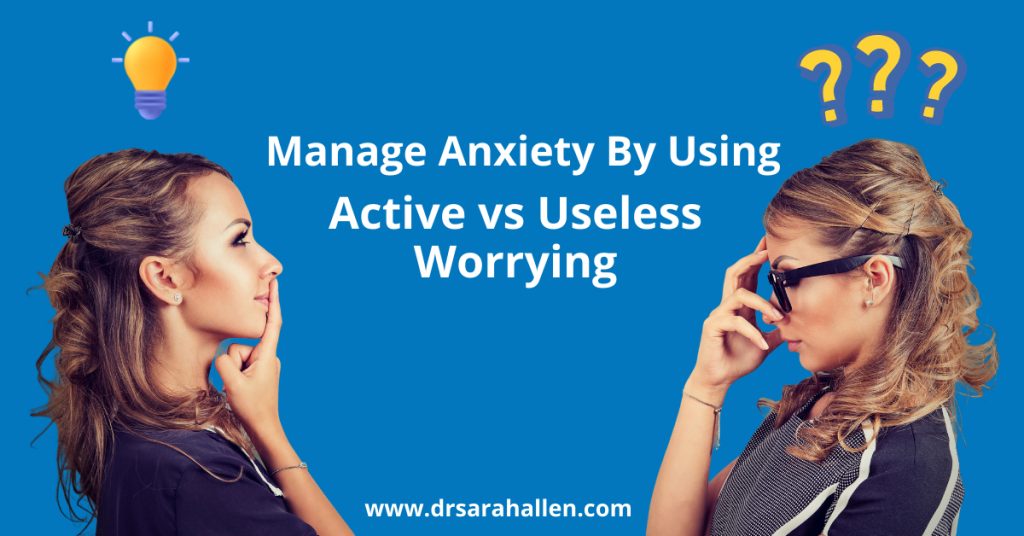
Active Worrying vs. Useless Worrying
Active worrying is your brain problem solving the worry so it leads to a useful outcome. It is:
Time-limited, not all day
Specific, not vague
Focused on things you can realistically influence
Aimed at creating a concrete plan
For example, you might think, “My credit card balance is higher than I want. Tonight I will look at my budget and determine where I can cut at least one subscription”. The worry points to a problem, then you outline steps to address it. Usually, once you put a plan in motion, your anxiety goes down.
Useless worrying looks different. It is:
Repetitive and looping
Vague or extreme
Filled with what if” questions about things you cannot fully control
Leaving you feeling stuck instead of moving forward
Here are a few examples to see the comparison between Active vs Useless Worrying
Finances
Active worrying: “I will review my bank account on Friday, list my bills, and call the utility company to ask about a payment plan.”
Useless worrying: “What if I end up in debt and lose everything?” repeated for hours, without making a single call or list.”
Parenting
Active worrying: “My child’s teacher mentioned focus issues. I will email to ask for examples and schedule a time to talk.”
Useless worrying: “What if my child fails at life because I am a bad parent?” with no specific situation or plan.”
Health
Active worrying: I found a new symptom. I will write down when it started, track how often it happens and schedule an appointment with my doctor.”
Useless worrying: What if this is something terrible and I die of cancer?” over and over, while avoiding checking with a professional.
Active worrying tends to lower anxiety over time because you do something. Useless worrying usually keeps anxiety the same or makes it worse.
How Useless Worrying Fuels Anxiety
Ongoing, useless worry can affect both your mind and body. When your brain keeps scanning for danger without resolution, your nervous system stays on high alert.
You might notice:
Muscle tension or headaches
Stomach issues Sleep problems, especially trouble falling or staying asleep
Irritability and feeling on edge
Trouble concentrating or making decisions
Generalized anxiety disorder, or GAD, is a mental health condition in which worry is frequent, hard to control, and spread across many areas of life. If you would like to read more about GAD read Understanding Generalized Anxiety Disorder.
To meet criteria for GAD, people typically:
Worry most days for at least several months about several areas of life, not just one
Find it very hard to control or turn off the worry
Have at least some physical symptoms, like feeling restless, tense, easily tired, or keyed up
Often experience irritability, poor concentration, and sleep disturbance connected to worry
Research on anxiety shows that excessive worry and rumination keep stress systems active, like an alarm that never fully switches off. Over time, pathways in the brain can become more practiced at going straight to worst-case thinking. That is part of why worry can start to feel automatic.
How Cognitive Behavioral Therapy (CBT) Can Help Reduce Worrying
Cognitive behavioral therapy (CBT) is an evidence-based treatment for GAD and other anxiety disorders and is one of the most well-studied approaches. CBT focuses on changing this worry cycle and helps you learn to:
Notice worry patterns and triggers
Question unhelpful thoughts instead of taking them at face value
Shift from vague what if” thinking to specific, active problem-solving
Gradually face situations you have been avoiding because of anxiety
Some people also benefit from the addition of other approaches, such as acceptance and commitment therapy (ACT) or mindfulness-based strategies, which help you relate differently to anxious thoughts rather than trying to eliminate them entirely. For some, medication such as SSRIs can be helpful alongside therapy, especially when symptoms are severe.

Turning Worry Into Action: Five Active Worrying Strategies
Strategy 1: CBT Thought Record
A CBT thought record helps you slow down a worry and look at it more clearly.
Basic steps:
Write down the situation that triggered your worry
Write the worry thought in one sentence
Rate how strongly you believe it (0 to 100)
List evidence that supports the thought
List evidence that does not support the thought
Write a more balanced, realistic thought
Example: You had a disagreement with your partner and your mind jumps to, This means our relationship is falling apart.
Evidence for: We argued, voices were raised, I felt distant afterward.
Evidence against: We have worked through arguments before, they said they care about the relationship, we agreed to talk later when calm.
Balanced thought: We had a hard argument, which is uncomfortable, but we have handled conflicts before. This is a sign we need to communicate, not proof that everything is over.
An important part of Cognitive Therapy is keeping track of unhelpful thoughts (also called negative cognitions). Together we will look at where theses types of thoughts come from, how they are holding us back and how to reframe them in a way that improves mood. The Thought Diary can be downloaded below and gives a structured way to identify unhelpful negative thoughts. Side 2 gives a list of questions that help us challenge these unhelpful negative thoughts.
Strategy 2: Problem-Solving Steps
When a worry is about a real, solvable problem, a simple problem-solving method can turn anxiety into action.
Try this:
Define the problem in one clear sentence
Brainstorm possible options without judging them
Choose one or two realistic options
Break them into small steps
Try the plan and later review how it went
Example: You are worried about a medical issue you have been avoiding.
Problem: I am worried about this symptom and have not seen a doctor.
Options: Call primary care, search online all night, talk to a friend, ignore it.
Choose: Call primary care.
Steps: Find the number, call during lunch, write questions down beforehand.
Review: After the visit, notice how your anxiety changed.
Strategy 3: Worry Time
Instead of worrying all day, you can contain worry in a specific daily “worry time.”
Pick a 15 to 20 minute window each day
When worries pop up outside that time, briefly jot them down and tell yourself, I will think about this during worry time.
During worry time, sit with your list and sort worries into: can act on now, can prepare for, cannot control.
At first, your brain will try to pull you back into worrying all day, but with practice, it learns that you will come back to the topic later. This builds a sense of control and often reduces how sticky worries feel.

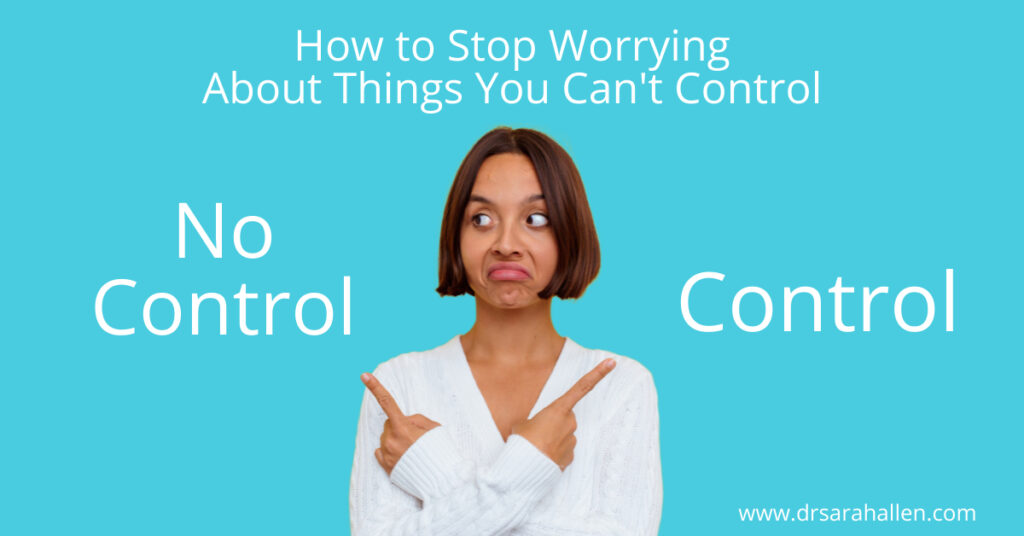
Strategy 4: Distinguish Controllable vs. Uncontrollable  path blog post
Not every worry deserves the same amount of mental energy. Sorting worries into categories can guide your response.
After identifying what you worrying about ask yourself:
Is this something I can do something about right now?
Is this something I can prepare for, even if I cannot control the outcome?
Is this something I truly cannot control at all?
Examples:
Can act now: I am worried I will be late with a bill.” Action: set a reminder, make a partial payment, call the company.
Can prepare: I am worried about a job interview result.” Action: practice answers for future interviews, update your resume.
Cannot control: I am worried about the overall economy. Action: focus on your budget and self-care, limit news, practice acceptance skills.
When you hit the cannot control” category, the task shifts from problem-solving to self-soothing: breathing exercises, grounding techniques, talking with a supportive person, or engaging in a calming activity.

Strategy 5: Behavioral Experiments
Behavioral experiments are a CBT tool where you test a worry in real life in a planned way.
Here Are The Steps:
Write down the feared prediction
Plan a small, safe action that tests it
Decide what outcome would count as “evidence”
Do the experiment and record what actually happened
Example: You worry, If I set a boundary with my friend, they will not like me anymore.”
Prediction: If I say I cannot talk late at night anymore, they will get very angry and end the friendship.
Experiment: Next time they call late, you say, I care about you and I am going to bed earlier, so I cannot talk past 10 p.m.
Result: Maybe they are a bit disappointed but still talk to you, or maybe they accept it easily. Either way, you get real information instead of letting the fear run your choices.
How To Know When You Need Profession Help To Stop Worrying
Here are warning signs that extra support from an anxiety specialist can help. These include:
Worrying most days about many topics
Feeling unable to control or turn off worries
Avoiding situations because of anxiety or panic
Major changes in sleep or appetite
Trouble functioning at work, in school, or in relationships
If you reach out to someone like myself who specializes in anxiety they will typically ask detailed questions about what you worry about, how long it lasts, and how it affects your daily life. In my practice, I use CBT and other evidence-based therapies to help people shift from useless, looping worry to more active, problem-focused thinking. I offer sessions in-person and through secure online video, focusing on practical tools, structured exercises, and skills that you can keep using long after therapy ends.
Taking the Next Step Toward Calmer, More Focused Worry
You cannot stop your brain from ever worrying, and that is not the goal. What you can change is how you respond when worry shows up and whether it pulls you into endless “what ifs” or nudges you toward thoughtful action. Active worrying respects that your mind is trying to protect you, but it gives that energy a healthier direction.
If you see your own worry patterns in the examples I have given of useless worry, it may help to pick just one or two of the strategies in this article and practice them consistently for a week or two. If worry feels constant, overwhelming, or out of your control, working with a therapist like myself who understands anxiety disorders can make this process much easier. With the right support, worry can become something you can guide and use more intentionally, instead of something that runs your life.

If anxiety is getting in the way of how you want to live, I can help you move forward with care and clarity. My personalized approach to anxiety disorder treatment in Chicago focuses on practical tools you can start using right away. For personalized anxiety (or one of the other issues I treat) treatment, contact me, Dr. Sarah Allen on the form below. I see clients in my office in Northbrook, a North Shore Chicago suburb, or virtually across IL, FL and the UK.
Reach out today to ask me any questions, schedule an appointment, or discuss what kind of support feels right for you, or contact me to get started.

If you have any questions, or would like to set up an appointment to work with me and learn how to reduce anxiety, please contact me at 847 791-7722 or on the form below.
If you would like to read more about me and my areas of specialty, please visit Dr. Sarah Allen Bio.
Dr. Allen’s professional licenses only allow her to work with clients who live in IL, FL & the UK and unfortunately does not allow her to give personalized advice via email to people who are not her clients.
Dr. Allen sees clients in person in her Northbrook, IL office or remotely via video or phone.

What Can I Read That Helps Me While I Am Waiting For My First Appointment With Sarah?
Download this free booklet to gain valuable insights and practical strategies for managing anxiety and worrying.



















As featured in