
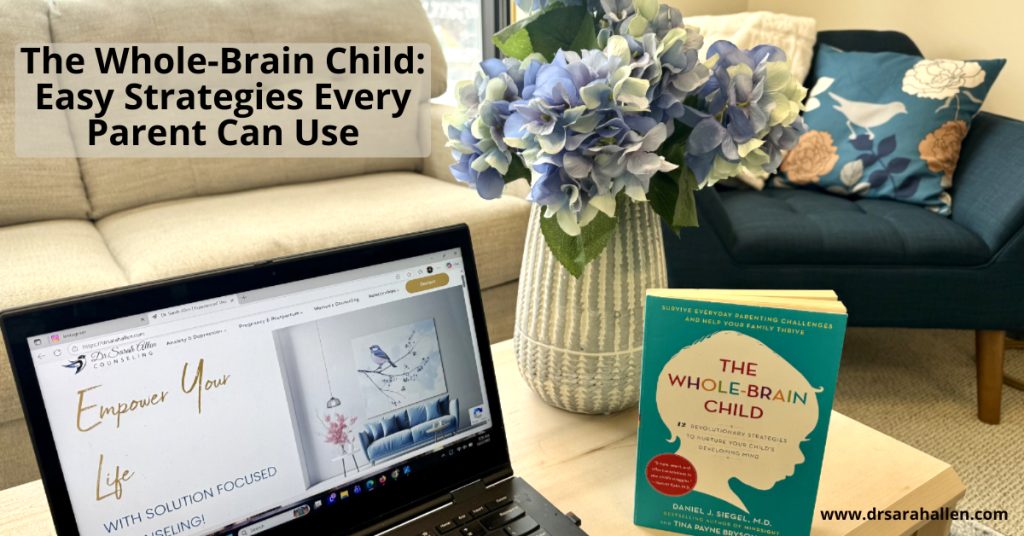
Parenting brings moments of connection, love, and pride. But mixed into those are the meltdowns, power struggles, and days that just feel tough. I have three children of my own so I have felt these things myself and I hear them regularly from the parents I work with too. When I read a book that I feel is very helpful to parents, I want to share it. I also realize that it can be hard to find time to read a whole book so here are the highlights from one of my favorite parenting books. You can start using these techniques today and read the book for more details when you can.

The book The Whole-Brain Child by Dr. Daniel J. Siegel and Dr. Tina Payne Bryson explains how children’s brains work and what happens when big emotions take over. It offers tools for bonding with your child while also setting firm limits, especially during those everyday power-struggle moments. If you have been looking for calmer ways to parent, these strategies can help you feel more prepared and less reactive. They are useful from toddler tantrums all the way through the tricky teen years. I also think they can be helpful for adults too!
Here is a link to Amazon if you would like to buy The Whole-Brain Child.
Understanding Your Child’s Brain
Children’s brains are still growing and organizing all the way through their teen years. That is part of why emotions seem so big and why their logic does not always work the way ours does.
The brain has different areas that control how we handle feelings, solve problems, and relate to others. One way we often explain it is through what the authors call the “upstairs” and “downstairs” brain. The upstairs brain is responsible for thinking and planning. The downstairs part reacts to emotions and threats. Little kids spend a lot more time using the downstairs part, and it takes effort and adult help to bring them back up to calm thinking.
Once you start seeing behavior through this lens, it becomes easier to figure out how to respond in a way that truly helps, not just stops the moment. Below I summarize 10 of the strategies from the Whole-Brained Child book in a simple way you can start using immediately.
Connect and Redirect
When emotions are high, logic is low. This means trying to explain or correct a misbehavior using only words often does not work. Instead, we recommend starting with connection, then redirecting behavior once your child is calm enough to listen.
• For toddlers, that might look like kneeling down, giving a hug, and saying, “You’re mad you can’t have the cookie” before offering another choice.
• For an older child, it might be pausing after a disrespectful tone to say, “I get that you’re upset,” then gently guiding them toward a better response.
This simple shift can lower power struggles, especially with anxious kids who already feel out of control.
Name It to Tame It
Young children do not automatically know how to name their feelings. Helping them say what they feel actually lowers the intensity of that emotion.
• For preschoolers, you might say, “You seem sad because we have to leave the park.”
• For tweens, it might be, “It sounds like you’re really embarrassed about what happened today.”
When kids hear you use feeling words for their experience, they often soften. It tells them, “You’re not alone. I see you.”
Engage, Don’t Enrage
No one likes to be bossed around or shouted at. During challenging moments, kids are much more likely to cooperate when they are engaged rather than threatened or punished.
• For younger kids, offer simple choices like, “Do you want to brush teeth first, or put on pajamas first?”
• For school-age children, I coach parents to talk calmly through the behavior: “How do you think that went?” or “What could we try differently tomorrow?”
This strategy builds problem-solving instead of pushing kids further into defiance.
Use the Upstairs Brain
Getting kids to access their “upstairs brain” helps them make better choices, but this part of the brain needs nurture and time to grow.
• With a preschooler, you could say, “Let’s stop and think. What will happen if you throw the toy again?”
• With older kids, it might be helping them create simple check-in rules: “Before we speak, let’s pause and ask, is what I want to say kind?”
The more our kids use their upstairs brain, the stronger it gets.
Move It or Lose It
Physical activity resets the brain when a child is stuck in meltdown mode. I often encourage parents to get kids moving when they seem emotionally flooded.
• Dancing, stomping, or jumping works well for younger children.
• A quick walk outside or a bit of stretching can help older kids reset.
Movement is not a distraction. It helps reconnect the body and brain so your child can calm down enough to think.
SIFT (Sensations, Images, Feelings, Thoughts)
This tool teaches kids to check in with what is going on inside their minds.
• A simple version for little ones might be saying, “Does your tummy feel jumpy right now?”
• For older children, try asking them to describe what they are sensing, picturing, and thinking when they feel upset.
Helping them name and notice these things gives you both clues for what they need.
Two Brains Approach – Integrate the Left and Right Brain
The left side of the brain loves facts and lists. The right handles emotion and imagery. Sometimes kids are stuck in one side or the other, and it helps to bring them together.
• For younger children, this might mean helping them draw what happened along with talking about it.
• For older kids, I suggest combining the facts of what went wrong with how they felt, and what they would like to change moving forward.
This balanced approach helps them feel heard while still learning from their actions.
Revisit and Remember
Kids build emotional strength by “replaying” past experiences with your support. When something hard happens, talk about it gently. This helps the brain file it away calmly.
• Preschoolers can retell the story of a meltdown with your help: “Was that before or after snack time? What did you do next?”
• Older kids might appreciate journaling or having short talks about what helped them bounce back after a stressful event.
Revisiting teaches that emotions pass and things can feel better again.
Let the Clouds of Emotion Pass
It helps to teach your child that big feelings do not last forever, even if they feel overwhelming in the moment.
• With toddlers, you can say, “You’re really upset right now. Let’s take deep breaths and wait for the mad to pass.”
• For older children, you might suggest saying, “Let’s give this a little time before we talk more. Emotions can be loud at first.”
Knowing that emotions come and go can help children stay steady instead of reacting fast.
Practice Mindsight
This is the ability to notice your own thoughts and feelings with detachment. It is a powerful way to build emotional control.
• For little kids, try modeling it first: “I’m feeling frustrated. I’m going to stop, take a breath, and then decide what to do next.”
• Older kids can learn to watch their thoughts and feelings like waves on a beach, they come, they go, and we do not have to believe everything they say.
Mindsight is especially useful for anxious children who get caught in worry loops. Gently helping them watch and name these feelings makes them more manageable.
Keep Communication Simple and Consistent
No parenting book or strategy makes everything easy, but I have seen over and over how parents feel calmer once they have some straightforward strategies to use, especially when they see them work. Talking with your child, rather than yelling or scolding, builds trust, teaches emotional awareness, and leads to better behavior over time.
Even small shifts, such as naming a feeling, offering a choice, and waiting a moment, can help break stressful patterns that leave everyone feeling discouraged. If you are a parent struggling with feeling overwhelmed, stressed or exhausted, you do not have to figure everything out at once. Simple, repeated conversations matter. You are doing more than you think.
Building Stronger Families
In both my Northbrook office and virtually across Illinois, Florida and the UK, I work with parents every day who want practical and compassionate ways to support their children’s emotional health and their own. Parenting strategies grounded in research, like those found in whole-brain parenting, are woven into therapy to help families communicate with less conflict and more understanding.
If you need extra support to manage anxiety and/ or parenting stress, you are not alone. I can help you feel more confident, encourage healthy attachment, and empower you to develop resilience within yourself and your children.
For personalized parenting support, contact Dr. Sarah Allen. She sees clients in her office in Northbrook, a North Shore Chicago suburb, or virtually across IL, FL, and the UK.
Parenting can feel overwhelming, I see how much mental load this stage of life brings and find that many parents feel more confident when they better understand both their child’s reactions and their own. If you have been considering starting counseling for new mothers or parenting coaching, I am here to help you find more calm and less stress in your day. Support is available in my office in Northbrook, a North Shore Chicago suburb, or virtually across IL, FL and the UK.

Parenting is tough and I am here to help you to be the parent you want to be. If you have any questions, or would like to set up an appointment to work with me, please contact me at 847 791-7722 or on the form below.
If you would like to read more about me and my areas of specialty, please visit Dr. Sarah Allen Bio. Parenting coaching is not covered by health insurance because insurance only covers mental health diagnoses. Dr. Allen’s professional license only allows her to work with clients who live in IL, FL & UK and unfortunately does not allow her to give personalized advice via email to people who are not her clients.
Dr. Allen sees clients in person in her Northbrook, IL office or remotely via video or phone.

What Can I Read That Helps Me While I Am Waiting For My First Appointment With Sarah?
One issue that I find comes up again and again is how to handle discipline and arguments within the family. So I put together a booklet with some strategies I am always saying to my clients to help them begin to improve their relationship with their child and reduce the amount of shouting, arguing and tantrums that can occur. I hope that you will find it helpful too.

















As featured in