Key Takeaways
- Social anxiety at work often involves outwardly looking confident while internally struggling with anxiety, dread and worry.
- Common signs can include over-preparing for emails and meetings, excessive worry and avoiding speaking due to fear of judgement.
- Research has shown that social anxiety in the workplace does not prevent success at work but can lead to internal distress and avoidance.
- Therapy with an anxiety specialist can help by focusing on coping strategies to use at work, overcoming fear of anxiety-provoking work situations and managing perfectionism and assertiveness.
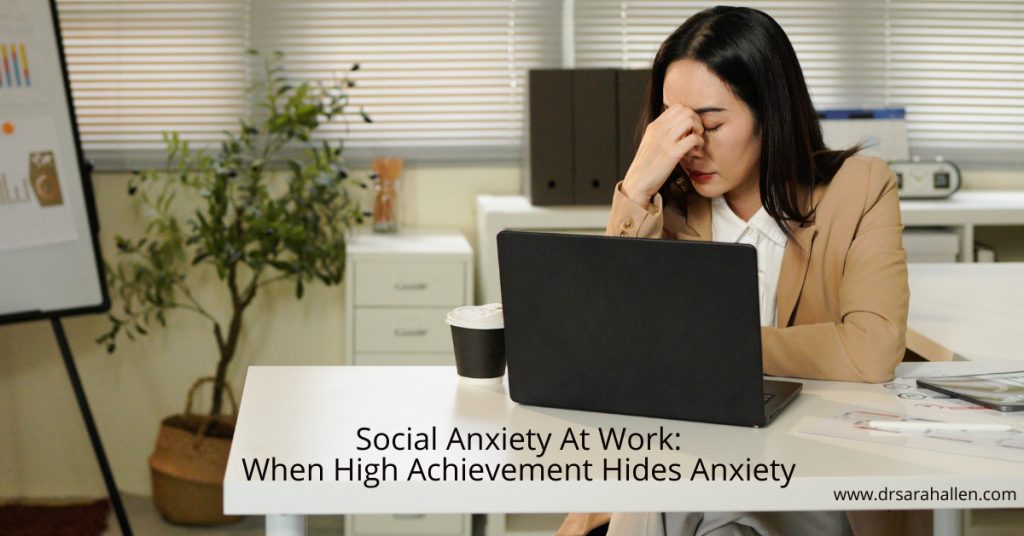
My clients often discuss social anxiety at work as looking confident on the outside but inside feeling a sense of dread and anticipatory anxiety. Coworkers come to you for help, your boss trusts you with important projects, and you are known as the person who gets things done. But after a meeting, your shoulders ache from tension, you replay every comment you made, and you feel drained for hours because you are replaying what you said and did in your mind.
That split between how you look and how you feel can be a sign of high-functioning social anxiety and as many people spend hours each day at work, it is not surprising that it shows up there too. This is not always the obvious panic response people imagine. For many professional women, it shows up as constant worry about how others see them, self-criticism after even small interactions, and a heavy pressure to never make a mistake.
In clinical terms, social anxiety is about a strong fear of negative evaluation. There is often intense worry before social or performance situations and a lot of rumination afterward. Perfectionism and over-preparation can cover it up, so on the outside, you might look like the star employee while inside you feel like you are barely holding it together.
Social anxiety doesn’t prevent someone from succeeding at work. Recent research on social anxiety and work functioning suggests that people with social anxiety often perform well at work but experience significant internal distress, especially around meetings, feedback, and performance reviews. Studies also show that women, in particular, report higher rates of social anxiety symptoms and more fear of negative evaluation in professional settings, likely because of both biological vulnerability and socialization to be agreeable, careful, and attuned to others’ reactions.
Many women, especially those juggling demanding jobs and care-giving roles, have learned to push through these feelings. You might tell yourself you are just being conscientious or that this is what success feels like. Social anxiety is very treatable, and noticing the signs is the first step. I will walk through what it can look like, why high achievers are especially at risk, practical steps you can try, and when it may be time to see a therapist like myself who specializes in anxiety.
Signs of Social Anxiety at Work
Social anxiety can hide behind “good” traits like being prepared, kind, and reliable. Some common signs include:
- Replaying conversations over and over, looking for what you did wrong
- Feeling embarrassed about small comments or questions you asked
- Anticipatory anxiety leads to avoiding speaking up in meetings unless you are absolutely sure you are right
- Over-apologizing in emails or softening your message again and again
People-pleasing often masks anxiety. You might:
- Volunteer to take on extra tasks to “make up for” a time you spoke up or disagreed
- Say yes to projects you do not have time for because you fear being seen as difficult
- Rewrite presentations until late at night because you are afraid of criticism
At work, this can look like turning down promotions because you do not want more visibility, avoiding networking events even though you know they help your career, or feeling a wave of dread when you see a meeting pop up on your calendar.
Research on women and anxiety suggests that girls and women are often socialized to be agreeable, careful, and self-critical. That can make social anxiety blend into what others see as being thoughtful or responsible. The emotional cost is high: exhaustion after social interactions, a sense of dread before workdays, and a belief that everyone else seems confident while you feel on edge.
Why High Achievers Can Experience Social Anxiety At Work
Many women with careers carry several roles at once. You might be an employee or leader, a partner, a parent, or a caregiver to an older adult. Each role can come with expectations to respond kindly, say the right thing, and avoid upsetting others. When social anxiety is present, it can feel like there is no off switch.
Workplace culture can add to this pressure. Performance reviews, public presentations, and competitive environments put attention on how you speak and act. Some workplaces expect you to be assertive and confident, yet also warm and approachable. That “be strong, but not too strong” message can make you second guess:
- Your tone in emails
- How quickly you answer questions
- How directly you share ideas or set limits
There is a link between perfectionism and fear of negative evaluation with increased social anxiety symptoms. Women often receive more feedback on communication style and likability, which can make this fear grow. You might find yourself wondering, “Was I too direct?” or “Did that email sound rude?” long after you hit send.
Remote or hybrid work can also affect social anxiety. On one hand, fewer in-person meetings may feel like relief. On the other hand, it can make it easier to avoid real-time conversations and harder to challenge anxious thoughts. You might spend extra time over-editing messages, delay turning on your camera, or worry for hours about how a short message came across.
How To Manage Social Anxiety at Work
While therapy offers more support and structure, there are steps you can start on your own to reduce social anxiety.
First, pay attention to your common anxious thoughts. Examples might be:
- “Everyone thinks I sounded uninformed in that meeting.”
- “If I say no, they will be mad or think I am lazy.”
- “I need to be prepared for every possible question.”
You can then practice more balanced alternatives, such as:
- “I shared a useful point, and no one expects me to be perfect.”
- “It is reasonable to set limits on my workload.”
- “I can prepare well, and it is okay not to know everything.”
Behavioral steps can be small and very specific. For example:
- Ask one question or share one idea in a meeting, even if your heart is racing
- Start a brief conversation with a coworker you like but usually avoid
- Practice saying, “I cannot take that on right now,” in lower-risk situations
Simple grounding tools can help your body feel calmer before and after stressful moments. You might try:
- Slow, paced breathing, lengthening the exhale
- Pressing your feet into the floor and relaxing your jaw and shoulders under the desk
- Taking a short walk or stretch break after an intense meeting
Journaling can also help separate anxiety from reality. You can track:
- The situation that triggered your anxiety
- The thoughts that showed up
- What you did in response
- How things actually turned out
These tools are similar to some strategies I utilize in my work with clients who experience social anxiety. In therapy, we will look closely at your anxious thoughts and habits, where the roots of your anxiety come from and challenge unhelpful thoughts while working through them with you in a structured, supportive way.
Social Anxiety Therapy For High-Achievers
When I meet with someone for the first time, my focus is on understanding your story, not judging it. I ask about your work environment, your roles at home, and the specific situations that trigger your anxiety. I look at when this started, what you have already tried, and how it is affecting your sleep, mood, and relationships.
I mainly use:
- Cognitive-behavioral therapy (CBT) to identify and shift anxious thoughts
- Exposure-based strategies to gradually face feared situations
- Solution-focused methods to build on strengths you already have
I tailor therapy to real-life situations. That might mean:
- Practicing how you want to speak in a performance review or staff meeting
- Planning how to respond when someone tries to add more to your plate
- Working on assertive communication that still feels like you, not like a script
Sessions can be in person or through online counseling, which can help when your schedule is already full. In anxiety counseling, I pay attention not just to the anxiety symptoms themselves, but also to the perfectionism, people-pleasing, and role overload that keep the anxiety going.
When To Seek Therapy For Social Anxiety
Many people wait a long time before seeking support for social anxiety because they think it is just “part of the job” or part of their personality. It may be time to get professional help if you notice:
- Frequent dread before workdays or specific meetings
- Intense rumination about interactions that lasts for hours or days
- Ongoing trouble falling or staying asleep
- Irritability or snapping at people you care about because you feel so on edge
- Turning down meaningful opportunities because you are afraid of being seen or judged
Life transitions often bring social anxiety into sharper focus. This can include starting a new leadership role, changing careers, returning to work after maternity leave, or stepping into a more public-facing position. The anxiety might have been there for years, but new demands make it harder to ignore.
Seeking support is not a sign that you cannot handle things. It is a way to stop pouring so much energy into managing anxiety and use that energy for work, relationships, and personal goals. Working with a therapist who specializes in anxiety and women’s experiences can shorten the time you feel stuck and offer tools that fit your specific life.
Anxiety counseling, whether in person or online, can help you reduce symptoms, feel more at ease in professional settings, and move toward a quieter, steadier confidence that is real on the inside, not just something you show on the outside.
Frequently Asked Questions About Social Anxiety At Work
Social anxiety at work often manifests as intense worry about doing something wrong, saying the wrong things and being judged by others. You may replay conversations in your mind, avoid speaking up unless you are certain that you are right, over-preparing for meetings or take a long time to write emails. Frequently it can lead to avoiding networking or having difficult conversations with co-workers and possibly not going for career opportunities that you are capable of.
Yes. You can definitely be successful and capable and be well regarded at work and still experience significant social anxiety. What people don’t see is how preparation, perfectionism and conscientiousness compensate for fear of judgement. The extra mental energy and hidden work you do is exhausting!
Yes. When fear of judgment leads to you avoiding opportunities and networking with other it can affect your career trajectory. Hesitating to share your ideas or stay silent in meetings means that colleagues and leaders don’t see your potential. Avoiding leadership roles can also limit opportunities. These patterns can limit you, even when you have the skills and experience. It can also lead to feelings of isolation which in turn can make you feel less satisfied in life.
If you asked your work colleagues to describe you, (which I know you would never want to do!) they may say that you are confident, meet deadlines, have strong presentation skills but keep yourself to yourself. They don’t see that privately you are worrying about being criticized and judged so you put in extra hours to manage your anxiety and perfectionism while outwardly making things seem easy for you.
Feeling social anxiety takes up a lot of your mental energy. If you lay awake replaying interactions and worrying about what people think of you, have anticipatory anxiety about future events and avoid social and career opportunities, it is time to reach out for specialist anxiety therapy. Life does not need to be this hard.
Get Help For Social Anxiety At Work
If anxiety is getting in the way of your work experience, relationships, or daily life, I am here to help you feel more grounded and in control. I tailor anxiety counseling to your specific concerns so you can move forward with practical tools and clarity. I see clients in person at my Northbrook office which is in the North Shore suburbs of Chicago, or virtually across Illinois, Florida and the UK. Reach out to me through my contact page or on the form below to schedule an appointment and begin taking charge of anxiety and making meaningful changes.

If you have any questions, or would like to set up an appointment to work with me and learn how to reduce anxiety, please contact me at 847 791-7722 or on the form below.
If you would like to read more about me and my areas of specialty, please visit Dr. Sarah Allen Bio.
Dr. Allen’s professional licenses only allow her to work with clients who live in IL, FL & the UK and unfortunately does not allow her to give personalized advice via email to people who are not her clients.
Dr. Allen sees clients in person in her Northbrook, IL office or remotely via video or phone.

What Can I Read That Helps Me While I Am Waiting For My First Appointment With Sarah?
Download this free booklet to gain valuable insights and practical strategies for managing anxiety and worrying.




















As featured in