
If you are reading this, you have probably recently had a baby, or are about to, and you are doing it without your own mother by your side. That might be because she has passed away, because she is seriously ill, because she lives far away, or because the relationship between you makes her support feel impossible or unsafe. Each of those situations is different, and each carries its own grief. What they have in common is that research now clearly shows that the absence of a mother during the postpartum period, matters for mental health. If you are mothering without a mother, you are not alone and there are some things that you can do that make it easier.
In this article, I want to walk you through what the research tells us, why this type of loss can be so hard, and most importantly, what actually helps.
Key Takeaways
- Many new mothers navigate postpartum without their own mothers, impacting mental health.
- The absence of a maternal grandmother uniquely affects support and well-being due to her specific role.
- Women grieving maternal absence should address their feelings, whether from loss, estrangement, or distance.
- Practical and emotional support can come from others; it’s crucial to identify different sources rather than a single replacement.
- It’s important to communicate your needs to healthcare providers before childbirth for better postpartum support.
Table of contents
- How Common Is Mothering Without A Mother, and How It Can Affect You?
- Why Losing Your Mother’s Support Can Affect You Differently Than Other Losses
- What Maternal Support Often Provides and Why It Is Hard to Replace
- Loss Does Not Only Mean Death
- When You Are Estranged From Your Mother
- When Old Grief Resurfaces
- The Link Between Maternal Absence and Postpartum Depression
- When Love and Grief Live in the Same Moment
- What Can Help When Your Mother Isn’t There
- Why It Is Worth Telling Your Provider Before the Baby Arrives
- Building Support That Covers the Same Functions
- You Do Not Have to Navigate This Alone
- What My Clients Ask About Mothering Without a Mother
How Common Is Mothering Without A Mother, and How It Can Affect You?
Around 1 in 3 new mothers enters the postpartum period without her own mother by her side, whether through death, illness, geographic distance, or estrangement. That is a significant number of women navigating one of the most physically and emotionally demanding transitions of their lives without the support that historically would have been there as a matter of course.
For a long time, this went largely unexamined in the research literature. The focus on postpartum mental health tended to center on hormonal factors, sleep deprivation, relationship stress, and infant temperament. The specific loss of maternal support was rarely named as its own risk factor. That has changed.
Research now shows clearly that the absence of a mother during the postpartum period has a real, measurable effect on a new mother’s mental health, and that the maternal grandmother’s role is one that nothing else fully replicates. If you have felt this in your bones, the science is now catching up to what you already knew.
Why Losing Your Mother’s Support Can Affect You Differently Than Other Losses
A 2023 meta-analysis of 11 studies, involving over 3,300 women, found a significant link between grandparental support and postpartum mental health outcomes. What stood out in the findings was that the protective effect was strongest when the support came from the mother’s own mother rather than from a partner, a friend, or even a paternal grandmother.
That finding matters, because it tells us something important: the maternal grandmother is not simply “extra help.” She occupies a specific role that carries its own psychological weight, and when she is absent, that gap is felt differently than other gaps in a support network. Part of why this is the case has to do with what she is able to offer that others cannot. Raising infants was never meant to fall to one or two people alone. The maternal grandmother has historically been one of the most important co-caregivers in that arrangement, reducing the physical and emotional load on a new mother.
What Maternal Support Often Provides and Why It Is Hard to Replace
Research identifies two distinct types of support that the maternal grandmother tends to offer a new mother, and both matter.
The first is practical: hands-on help with the baby, feeding support, help with sleep, assistance with household tasks, and support during physical recovery from birth. The second is emotional: reassurance, normalizing the overwhelm, and simply validating that this is hard.
That is a distinction worth pausing on. A grandmother who has been through birth and early motherhood can offer something other supporters genuinely cannot, which is lived experience in the same role. When she says “this is hard and it does get easier,” it carries a different kind of weight than when anyone else says it. Research suggests this is part of the reason the maternal grandmother effect is stronger than that of other grandparents, including the paternal grandmother.
Both types of support, practical and emotional, are independently linked to lower rates of postpartum depression. It is the combination of the two, showing up reliably in the same person, that makes this relationship particularly hard to replace.
Loss Does Not Only Mean Death
One of the most important things I want to say in this article is that you do not need to have lost your mother to death to be grieving her absence right now. The absence of a mother in the postpartum period can come from several different circumstances: death, serious illness, geographic distance, or estrangement. Each one carries its own particular grief and all of them can have an effect.
Women who have lost their mothers to illness may be managing a layered grief, caring for their baby while also worrying about, or mourning, a parent. Women whose mothers live far away may feel the distance acutely during a time when proximity would have mattered most. And women who are estranged from their mothers, or whose mothers are not safe to lean on, carry one of the most complicated griefs of all: the longing for something that was never quite there, or that came at too high a cost.
Whatever the reason your mother is absent from this period of your life, the difficulty you feel is not disproportionate. The research shows it is real, and it is worth taking seriously and addressing.
When You Are Estranged From Your Mother
Around 6% of adults report being estranged from their mothers. If you are in that group and you have just become a parent, you may be finding that the estrangement is sitting differently now than it did before.
Becoming a parent often intensifies the complexity of estrangement. It can bring up longing, guilt, and sometimes a strong pull to reach out, even when you know that doing so would not be safe or wise. Many of my clients who are in this situation describe a version of the same experience: knowing in their minds why the estrangement was necessary, and still feeling the pull toward their mother in the weeks after having a baby.
That longing makes complete sense. Wanting your mother when you have just had a baby is completely understandable but often it is more wanting a fantasy of a good mother and that feeling does not obligate you to act on it in ways that would put you at risk emotionally.
If you are navigating this, please be gentle with yourself. The grief of estrangement during the postpartum period is hard, and it deserves attention and support.
When Old Grief Resurfaces
For women who have lost their mothers, whether recently or years ago, the arrival of a baby has a way of reopening that grief in ways that can feel surprising, even alarming. Research on mothers who lost their own mothers has found that becoming a parent frequently brings the grief back, even when a significant amount of time has passed since the loss.
This happens because the milestones of new parenthood, the first feed, the first smile, the first time you feel completely out of your depth at 3am, are all moments that would have been shared with your mother if she were here. They become sites of renewed loss, not because you have failed to heal, but because healing does not mean these moments stop mattering. They matter precisely because they were supposed to be shared.
If you find yourself grieving your mother again in the weeks and months after having a baby, that is not a sign that something has gone wrong with your recovery. It is a completely natural response to a life transition that was meant to be experienced alongside her. Many of my clients find it helpful to name this specifically, to acknowledge that the grief is not just about the past, but about what is happening right now and what she is missing.
The Link Between Maternal Absence and Postpartum Depression
Low social support is one of the most consistently identified risk factors for postpartum depression across the research literature. For mothers who are entering the postpartum period without their own mother’s support, that risk is elevated. The peer-reviewed evidence points consistently in the same direction: less maternal support corresponds to greater vulnerability to postpartum depression and anxiety.
What concerns me, both as a therapist and as the Founding Director of the Postpartum Depression Alliance of Illinois, is that this particular risk factor is rarely screened for. Research suggests that many mothers in this situation are never asked about whether they had their own mother’s support. Of those who were asked, only about half felt that the response they received was meaningful.
Grief-aware postpartum care, the kind that asks about this, acknowledges it, and offers real follow-through, remains the exception rather than the norm. That means many women are navigating an elevated risk for postpartum depression without anyone in their care team even knowing the risk is there.
If you are in this situation, I want to encourage you to name it, even if no one asks. Tell your OB, your midwife, your GP, or your therapist that you are entering the postpartum period without your mother’s support. You do not need to wait to be asked. The earlier you can flag it, the more support can be put in place.
When Love and Grief Live in the Same Moment
One of the most disorienting experiences for new mothers in this situation is the way love and grief exist side by side, sometimes in the same moment. You may be watching your baby sleep, or holding them through a 3am feed, and feeling your mother’s absence with the same intensity as everything else you are feeling. Both at once.
Bereavement research consistently shows that love and grief can and do coexist, and that allowing both, rather than trying to suppress one, actually reduces shame and confusion. Feeling loss in a moment of tenderness does not cancel the tenderness. And feeling tenderness does not mean the grief is behind you. Many of my clients find that giving themselves permission to hold both things at once, rather than waiting until they feel “purely” one or the other, brings real relief.
What Can Help When Your Mother Isn’t There
The research on postpartum social support is consistently shows that the quality and fit of support matters more than the source. A maternal grandmother cannot be replaced, and I do not think it is helpful to pretend otherwise. But the practical and emotional functions she provides can be distributed across other people in your life, and that does make a measurable difference.
Rather than looking for one person to fill the whole gap, it can help to think about who in your life can cover different parts of what you need. Who can offer hands-on practical help, an extra set of hands with the baby, a cooked meal, help around the house? Who can offer emotional support from someone who genuinely understands what new motherhood is like? Where can you find normalization, the reassurance from women who have been through it that what you are experiencing is real and survivable? And where can you find community with other mothers who are navigating something similar? These do not need to come from the same person.
It is also worth considering working with a therapist who specializes in maternal mental health. Not because something is wrong with you, but because having a space to process the grief alongside the transition into motherhood, with someone who understands both, can make a significant difference. Cognitive behavioral therapy (CBT) is well-researched for postpartum depression and anxiety, and it can also help with the complicated grief that often sits alongside it.
Why It Is Worth Telling Your Provider Before the Baby Arrives
If you are pregnant and you know you will be entering the postpartum period without your mother’s support, I encourage you to raise this before your baby arrives rather than after. Mothers in this situation carry elevated risk for postpartum depression, and early support, put in place proactively rather than reactively, reduces both the likelihood and the severity of longer episodes.
You do not need to wait until you are struggling to reach out. In fact, the earlier you can talk to someone, whether that is your doctor, your midwife, or a therapist, the better positioned you will be when the hard moments come.
Building Support That Covers the Same Functions
When thinking practically about how to build your support network, it helps to map the different functions rather than searching for one person to fill them all. Consider who in your life might be able to offer:
- Hands-on practical help, whether paid or from someone in your personal life
- Emotional support from someone who really gets it, perhaps a close friend who is already a mother, a postpartum doula, or a therapist
- Normalization from women who have been through early motherhood and can honestly say “yes, this is how hard it is, and it does change”
- Community with other mothers who are in a similar situation, whether through a local new mothers’ group, an online community, or peer support
I have written two posts that you can share with your partner and friends so they know how they can support you:
Supporting Moms with Postpartum Anxiety: Guide for Partners
How To Support A New Mom Who Is Struggling With Postpartum Depression
You Do Not Have to Navigate This Alone
If your mother is not here with you in this season of your life, whatever the reason, the difficulty you feel is real and is not an overreaction. The research is clear that the absence of a maternal grandmother during the postpartum period matters for mental health, and that the women who navigate this deserve acknowledgment and support.
You may well be fine, and you will find your way through this. But you deserve more than “fine.” You deserve real support, space to grieve what is missing alongside what you are gaining, and people around you who understand why this particular absence is so significant.
If you would like to work with me, I offer counseling in person at my Northbrook, IL office and virtually throughout Illinois, Florida, and the UK. Please feel free to reach out through my contact page, the form below or call me at 847 791-7722. I also have a free guide to pregnancy and postpartum mood issues that you can download from my pregnancy and postpartum page. I am here to help.
What My Clients Ask About Mothering Without a Mother
A: Yes. Research consistently identifies low social support as one of the strongest risk factors for postpartum depression, and studies specifically on support from grandparents show that the absence of the maternal grandmother carries a measurable effect on postpartum mental health outcomes. If you are entering the postpartum period without your mother’s support, whether she has died, is ill, lives far away, or the relationship is not one you can safely lean on, that is a real risk factor worth naming to your doctor or midwife, ideally before your baby arrives.
A: Because birth and early parenthood are transitions that were meant to be shared with her. The milestones of new motherhood, the first feed, the first sleepless night, the first moment you feel completely out of your depth, are all moments that would have involved her if she were here. Research on bereaved mothers consistently shows that becoming a parent reactivates grief, even when the loss happened years ago. This is not a sign that something has gone wrong with your healing. It is a natural response to a life event that carries her absence in a new and specific way.
A: Yes, and it is one of the most common things I hear from clients in this situation. Wanting your mother when you have just had a baby is one of the most human responses there is. It does not mean the estrangement was wrong, or that you need to revisit it. It means you are a new mother, and new mothers need their mothers. Feeling that pull is not a signal to act on. It is a signal that you are going through something significant and deserve real support. Please be gentle with yourself.
A: The research suggests that thinking about specific functions rather than trying to find one person to fill the whole gap is the most useful approach. That means identifying who can offer hands-on practical help, who can offer genuine emotional support from experience, and where you can find community with others in a similar situation. These do not need to come from the same person. A postpartum doula, a close friend who is already a mother, a new mothers’ group, and a therapist who specializes in maternal mental health can each cover different parts of what you need.
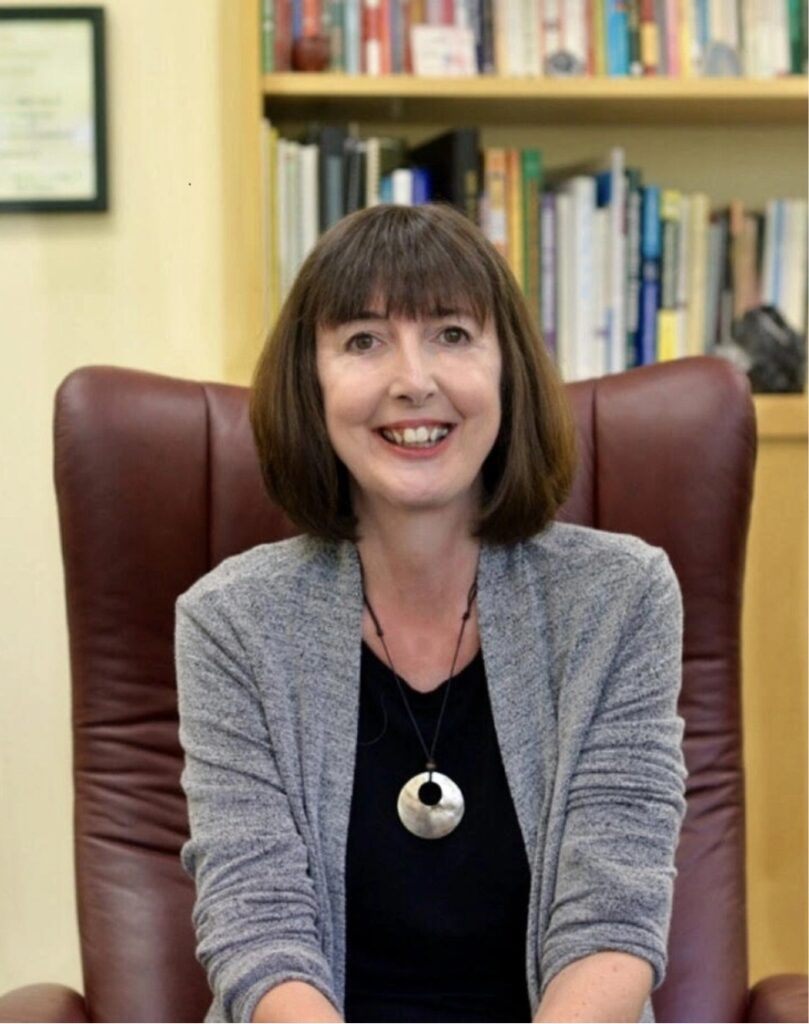
Dr. Sarah Allen has 25+ years of experience in private practice helping women to transition to being the mom they want to be. She is the Founding Director of the statewide non-profit Postpartum Depression Alliance of IL. She also specializes in pregnancy loss & infertility & has published research on postpartum depression and traumatic childbirth.
If you would like to work with Sarah, please phone her at 847 791-7722 or on the form below.
If you would like to read more about me and my areas of specialty, please visit Dr. Sarah Allen Bio. Dr. Allen’s professional license only allow her to work with clients who live in IL, FL & the UK and unfortunately does not allow her to give personalized advice via email to people who are not her clients.
Dr. Allen sees clients in person in her Northbrook, IL office or remotely via video or phone.

What Can I Read That Helps Me While I Am Waiting For My First Appointment With Sarah?
If you feel that you may be experiencing pregnancy or postpartum mood disorder, or worry that you may be at risk of developing it, please download my free booklets below.
See each specific webpage to download one or many.

As featured in